Authentication
Hinata ships a complete local authentication system:
- username/password login
- optional self-registration with email verification
- forgot password, with a deep link into the app
- optional admin approval of new accounts
- time-based two-factor authentication
You toggle every mode at runtime from the Admin area, with no restart or redeploy.
For federated login (OpenID Connect, OAuth 2.0, SAML 2.0, LDAP) see Single sign-on. Hardening and the threat model are covered in the Security model.
Local credentials
Users sign in with a username (or email) and password. Passwords are hashed with BCrypt (strength 12) and never stored or logged in the clear. On success the server issues a short-lived JWT access token and a refresh token. The app stores both per server and refreshes them automatically.
Password rules enforced by the server:
- Minimum 10 characters. Length is the strongest lever against brute force.
- Hashed with BCrypt strength 12, so each verification is deliberately slow.
Length over complexity
Hinata requires length instead of lots of special-character rules. A 10+ character passphrase is stronger and easier to remember. Encourage your users to use a password manager.
Feature flags: AuthPolicy
Three flags control local authentication. They live in an AuthPolicy stored in MongoDB and are editable from Admin → Users / App. The database value overrides the environment default and takes effect without a restart.
| Flag | What it controls | Typical default |
|---|---|---|
localAuthEnabled | Whether username/password login is allowed at all. Turn it off to force SSO only. | true |
registrationEnabled | Whether visitors can self-register from the app. Off means admins create every account. | depends on deployment |
requireAdminApproval | Whether a newly registered (and email-verified) account must be approved by an admin before it can sign in. | false |
The app reads the effective policy from the public /api/v1/meta endpoint on launch and adapts the login screen. With registration off, the register link is hidden. With local auth off, the password form is hidden.
SSO-only deployments
Set localAuthEnabled = false once your SSO provider is configured and every user has a federated identity. The password form disappears and only the SSO buttons remain. You can always turn it back on to recover access.
Self-registration and email verification
When registrationEnabled is on, the app shows a Create account flow:
- The visitor submits a display name, username, email and password (checked against the password rules above).
- The server creates the account as unverified and emails a verification link.
- The link opens the app (deep link) or the web build and confirms the email with the server.
- If
requireAdminApprovalis on, the account then waits as pending until an admin approves it under Admin → Users. Otherwise the user can sign in right after verifying.
Email must actually work
Verification, approval and password reset all depend on outbound mail. Configure HINATA_SMTP_* and HINATA_MAIL_FROM before enabling self-registration, and confirm delivery. See E-mail & SMTP. In development the stack ships Mailpit, so you can read every message locally.
Optional admin approval
With requireAdminApproval = true, verified accounts land in a pending list. Admins approve or reject them under Admin → Users. This is the recommended setup for an open registration form on a public network: anyone can request access, and a person decides.
Forgot password
The reset flow runs in the app and reveals nothing about which addresses exist:
- On the login screen the user taps Forgot password? and enters their email.
- The server always responds the same way and never confirms whether an address is registered. If the account exists, it emails a reset link.
- The link carries a single-use token and opens the app through the
hinata://deep link (or an HTTPS universal link tohttps://track.example.comon platforms configured for it). The app renders the reset screen itself. The backend serves no password HTML. - The user sets a new password (again at least 10 characters) and the token is consumed.
Why a deep link?
With the reset screen inside the app, there is no server-rendered password page to harden, theme and localize separately. The email only hands a token back to the client you already trust. On native platforms the app registers the hinata://auth-callback / reset scheme. On the web build the universal link opens the same route.
Two-factor authentication (TOTP)
Hinata supports time-based one-time passwords (TOTP): the six-digit codes from Google Authenticator, 1Password, Aegis and similar apps.
Enabling 2FA
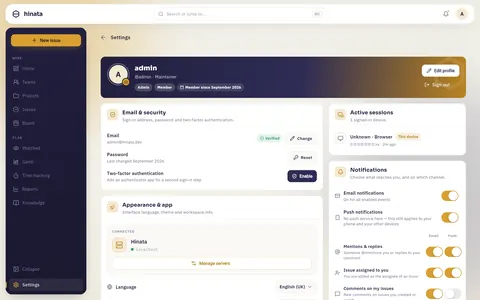
From Settings (the /settings account screen) a user opens the two-factor section:
- The server generates a TOTP secret and returns an
otpauth://provisioning URI, shown as a QR code. - The user scans it with their authenticator app.
- They enter a current 6-digit code, which activates 2FA on the account.
The login 2FA challenge
With TOTP enabled, login takes two steps:
- The user submits username and password. If the credentials are valid, the server responds with a 2FA challenge instead of tokens.
- The app asks for the current 6-digit code. Only after a correct code does the server issue the access and refresh tokens.
Keep a recovery path
Treat the authenticator device as a credential. If a user loses it, an admin can reset the account's second factor from the Admin area so the user can re-enrol.
Sessions
Every successful login creates a record in a sessions collection in MongoDB. The issued JWT carries a session id (sid) claim that ties the token to that record. That makes tokens individually revocable: signing out or revoking a session invalidates its sid. A leaked token can be killed without rotating the global signing secret.
Session management
From Settings users see their active sessions (device / client, last activity) and can revoke any of them, for example after signing in on a shared machine. A revoked session's tokens are rejected immediately.
Refresh tokens are for refresh only
Access and refresh tokens are distinct. A refresh token is accepted only at the refresh endpoint to mint a new access token. The rest of the API rejects it. See the Security model for the full token design.
Account, privacy and avatar
The same /settings screen is where users manage their own account:
- Profile: display name and details.
- Email change: the new address is verified again.
- Notification matrix: in-app and e-mail preferences per category.
- Avatar upload: a profile picture stored in S3/MinIO. Uploaded via the account API, served through a private-bucket proxy, capped and re-encoded server-side. Users can upload or remove it at any time.
- GDPR export & delete: users can export their personal data and delete their account themselves. That covers data portability and the right to erasure without an admin ticket.
GDPR by design
Hinata is self-hosted, so the data never leaves your infrastructure. With export and delete built into the app, you can answer access and erasure requests directly.
Where to go next
- Single sign-on: replace or complement local login with OIDC, OAuth 2.0, SAML 2.0 or LDAP.
- Security model: JWT design, rate limiting, login lockout, headers and the OWASP mapping.
- Admin area: where the AuthPolicy flags, user approval and app settings live.